
Healthcare organizations face a severe operational crisis today. Administrative tasks consume a growing portion of clinician time every single day. According to the American Medical Association, physicians spend 49% of their workday on EHR tasks and desk work. They spend only 27% on direct patient interaction. This imbalance drives exhaustion, frustration, and low job satisfaction nationwide. Workforce shortages further increase pressure across hospitals and outpatient clinics. Therefore, organizations must improve efficiency without adding staff burnout. RPM Workflows integrated with automation are becoming essential solutions. Additionally, healthcare leaders now recognize burnout as a clinical and financial risk. Sustainable care delivery depends on reducing unnecessary administrative burden.
RPM Workflows Eliminate Disconnected Systems
Many healthcare organizations still rely on fragmented systems and disconnected workflows. Clinicians navigate multiple platforms for documentation, billing, and patient monitoring daily. Consequently, operational complexity continues increasing across care teams. According to the Medical Group Management Association, fragmented workflows contribute significantly to clinician stress and inefficiency. Nearly 70% of ambulatory clinics report workflow bottlenecks increase costs and delay care.
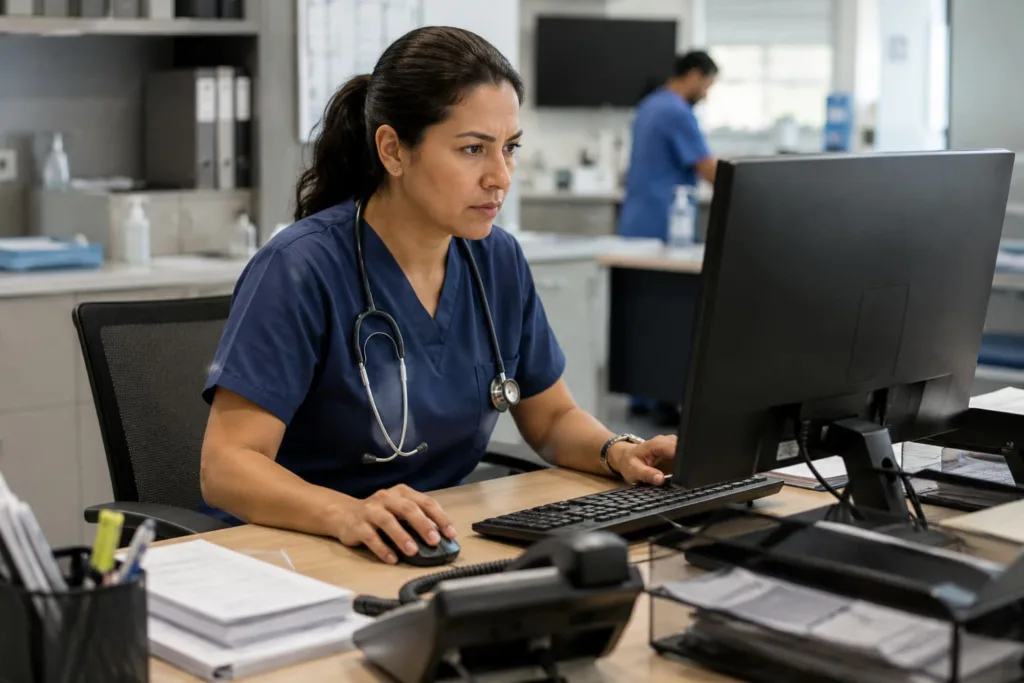
Repetitive manual tasks reduce productivity and increase administrative fatigue. Therefore, disconnected systems directly impact workforce sustainability and patient experience. RPM Workflows integrated with EHR platforms reduce these inefficiencies substantially. Coordinated systems improve visibility across patient populations. They also streamline communication between care teams. Organizations using integrated workflows improve operational consistency and reduce duplication.
RPM Workflows Enable Smarter Care Coordination
RPM Workflows become significantly more effective when integrated directly into clinical operations. EHR-connected systems allow clinicians to access monitoring data without switching platforms repeatedly. Automated alerts help prioritize patients requiring immediate attention. This reduces time spent reviewing low-priority information manually. According to the National Academy of Medicine, automating administrative workflows reduces burnout and increases patient safety. The NAM explicitly recommends automation to optimize healthcare team workflows. Consequently, RPM Workflows must support coordinated and centralized care management. Integrated reporting and communication tools improve collaboration across clinical teams. As a result, organizations reduce operational friction while improving care continuity.
RPM Workflows Reduce Manual Follow-Up Burden
Manual follow-up processes create substantial operational strain across healthcare organizations. Clinicians often spend hours coordinating communication, reviewing records, and documenting repetitive tasks. Therefore, burnout risks continue increasing across care teams. Automated RPM Workflows reduce this burden through centralized coordination and intelligent task management. Automated communication systems improve patient engagement while reducing repetitive outreach responsibilities. According to CMS operational guidance, structured digital workflows improve efficiency and care coordination performance. The Veterans Health Administration leveraged a centralized RPM team to achieve a 33% decrease in hospital admissions. This enabled clinicians to focus on urgent interventions. Thus, automation is becoming essential for sustainable care delivery.
Why Esvyda Delivers Sustainable RPM Workflows
Esvyda provides an integrated platform designed to reduce clinician burnout and improve sustainability. The platform combines automation, population management, analytics, and EHR integration into unified workflows. Esvyda is bilingual, secure, and fully compliant with CMS requirements. Key capabilities include automated data entry, intelligent alerts for high-acuity patients, and seamless EHR synchronization. Clinically, Esvyda improves outcomes like A1C and blood pressure control through proactive monitoring.
Patients experience higher satisfaction through accessible, culturally responsive bilingual tools. Effective care coordination reduces redundant tasks, allowing teams to focus on meaningful interactions. Moreover, Esvyda increases clinical productivity by enabling higher patient volume without extra staff. Partner with Esvyda to transform administrative burden into operational advantage.
Rural Health Hub

Download this artice
RPM Workflows Reduce Clinician Burnout
RPM Workflows cut clinician burnout via automation and EHR sync. Reduce admin time, boost retention, and enhance care coordination. Esvyda provides an integrated platform designed to reduce clinician burnout and improve sustainability.
Click Here