Remote Patient Monitoring can provide healthcare teams with useful information between visits. However, collecting measurements alone does not ensure appropriate follow up. High risk patients may experience changing symptoms or medication concerns. The real challenge is connecting incoming information with decisions and coordinated care. CMS describes RPM as connected devices, data transmission, clinical review, and treatment management. That definition matters because it places clinical review at the center. Without clear workflows, data can accumulate without producing action. Teams need to know who reviews readings, who contacts patients, and when escalation is required. RPM Data becomes valuable only when it informs clinical action within a coordinated process. Institutions should therefore design monitoring programs around responsibilities, response expectations, and documented follow up rather than device deployment alone.
RPM Data Needs Clinical Context and Clear Workflows
Patients with chronic or multiple conditions may need support beyond periodic encounters. Measurements such as blood pressure, glucose, and weight can reveal changing patterns. Connected devices allow patients to collect these readings outside traditional settings. When transmitted reliably, information can help clinicians observe trends between appointments. Still, broader visibility does not replace clinical assessment or guarantee early detection. Instead, it gives care teams another source of information for evaluating patient needs. Individual readings rarely tell the complete story. Clinicians must interpret them alongside history, symptoms, medications, and care goals. Trends over time often provide more context than isolated values. Effective RPM Data workflows therefore connect review with clinical judgment. Teams should establish thresholds and review schedules based on patient needs.
RPM Data Supports Coordinated Care Teams
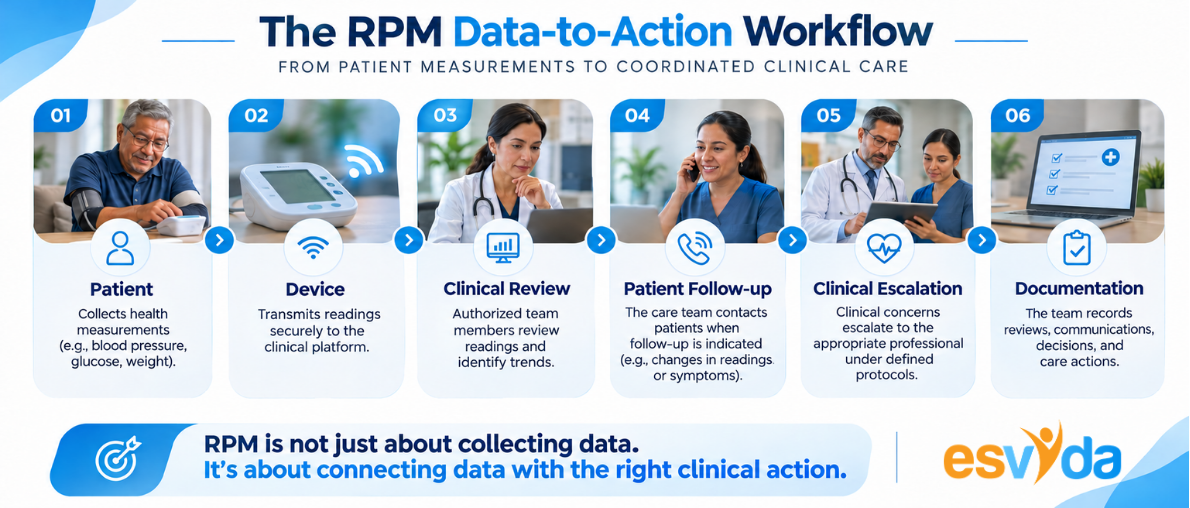
A defined workflow helps transform measurements into appropriate follow up. Institutions can organize the process around six connected steps. Patients collect readings with connected devices according to their monitoring plan. Measurements then transmit to the designated platform or clinical system. Authorized team members review readings and relevant trends. Staff contact patients when follow up is indicated. Clinical concerns escalate to the appropriate professional under established protocols. Finally, teams document reviews, communications, decisions, and actions. Clear responsibilities reduce ambiguity across these steps. Organizations should also define coverage arrangements and response expectations. CMS identifies data collection, transmission, review, and treatment management as core RPM components. The workflow should address technical issues, missing readings, and patient questions. These processes help RPM Data support care rather than create disconnected data streams.
RPM Data Helps Organizations Evaluate Care Processes
Remote monitoring often involves multiple professionals supporting the same patient. Physicians may evaluate clinical changes while nurses review measurements. Support staff may coordinate outreach and scheduling. These activities require shared information and clear accountability. AHRQ describes care coordination as organizing activities and sharing information among everyone involved in care. Its recommended practices include proactive planning, communication, monitoring, and follow up. RPM can complement Chronic Care Management when services and workflows fit the patient. Together, these approaches can support longitudinal communication and coordinated activities. Institutions should establish how team members access information and document responsibilities. This helps connect monitoring with the broader care plan while preserving clinical oversight. RPM Data becomes more useful when teams share a consistent view of patient needs and follow up actions
How Esvyda Connects RPM Data With Care
Healthcare institutions can assess whether monitoring workflows support timely and coordinated care. Useful indicators include patient engagement, review timeliness, response times, documented outreach, escalation completion, and care team coordination. These indicators should be interpreted alongside patient needs, staffing, and clinical context. Research on RPM outcomes remains mixed across populations and interventions.
Rural Health Hub
Therefore, institutions should avoid assuming monitoring automatically reduces utilization. Instead, they can evaluate whether implementation connects information with appropriate action. Esvyda helps connect Remote Patient Monitoring, Chronic Care Management, engagement, analytics, and reporting within one environment. Its bilingual, secure, and compliant platform supports communication across diverse populations. Specific outcomes depend on implementation and protocols. Still, Esvyda helps teams connect RPM Data with clinical workflows, visibility, and coordinated follow up.
Download this artice
RPM Data: From Monitoring to Clinical Action
Remote Patient Monitoring can provide healthcare teams with useful information between visits. Healthcare institutions can assess whether monitoring workflows support timely and coordinated care.
Click Here