(Connected Care for High Risk Chronic Patients) High risk chronic patients can experience important changes between scheduled clinical visits. Blood pressure, glucose levels, symptoms, medication adherence, and other factors can change quickly. For healthcare organizations, the challenge extends beyond understanding a patient’s condition during appointments. Teams also need visibility into what happens between encounters.
This becomes especially important when patients manage multiple chronic conditions requiring coordinated support. The CDC notes that people with multiple chronic conditions may require increased coordination among healthcare professionals and social programs. Connected Care can extend visibility beyond traditional encounters by connecting patient information with ongoing care processes. Instead of relying exclusively on periodic visits, organizations can create workflows supporting continuous observation, communication, and follow up. This broader visibility helps care teams understand changing needs and respond within established clinical protocols.
Connected Care Turns Patient Data Into Clinical Action
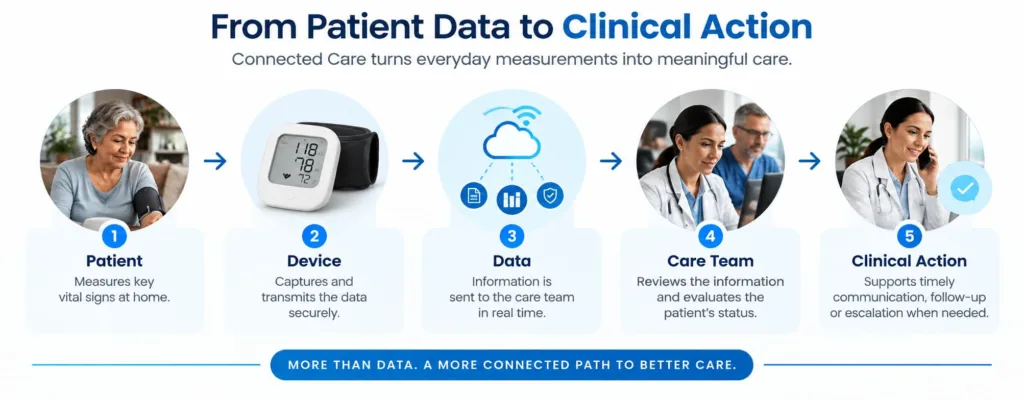
Connected Care becomes valuable when patient generated information supports appropriate clinical action. Connected devices can transmit physiological measurements to healthcare teams, creating additional information between scheduled encounters. However, collecting measurements alone does not create better care. The information must reach the appropriate team members and support defined workflows, follow up, or escalation processes.
A systematic review of remote monitoring technologies identified applications across diabetes and cardiovascular disease, while highlighting challenges integrating information into existing systems. The practical workflow can therefore be understood as Patient, Device, Data, Care Team, and Clinical Action. This structure connects monitoring with care management rather than treating data collection as an isolated activity. When organizations establish clear responsibilities, teams can use available information to support timely communication and coordinated patient management.
Connected Care Creates a More Complete Patient Journey
A connected care model extends beyond physiological measurements. Patient communications, education, follow up, care management activities, and coordination between team members can all contribute to understanding the broader care journey. AHRQ describes care coordination as deliberately organizing care activities and sharing information among participants to achieve safer and more effective care.
This approach becomes particularly relevant for high risk populations requiring multiple interactions across different care processes. Research also suggests that remote monitoring can support earlier clinical assessment, self management, and shared decision making for people with chronic conditions. Therefore, organizations should evaluate Connected Care as an ecosystem rather than simply a monitoring tool. The objective is greater visibility across the patient’s journey, allowing teams to connect information, communication, and follow up within coordinated workflows.
Makes Documentation and Traceability More Visible
Digital care generates multiple forms of information that can help organizations understand what occurred during a patient’s care journey. Depending on platform configuration and integrations, this information may include transmitted measurements, patient communications, care team interactions, notes, follow up activities, dates, timestamps, and user activity. Documentation does not automatically become part of the medical record, nor does digital traceability guarantee audit readiness.
However, organized information can improve operational visibility and help teams reconstruct relevant care activities. AHRQ emphasizes information transfer as an important component of coordination, including clinical information shared electronically. This creates an important principle for digital care: if care happens digitally, its documentation should remain visible within appropriate systems. Better traceability can support continuity, accountability, workflow management, and preparation for documentation requests.
Strengthens Revenue Integrity and Sustainability
When organizations can connect patient data, documented interactions, care activities, and timestamps, they gain greater visibility into how services were delivered. This does not guarantee reimbursement, because billing depends on applicable requirements, documentation, medical necessity, and organizational policies. However, stronger traceability can help teams identify available documentation and reconstruct relevant care processes.
Rural Health Hub
Economic evidence also shows that RPM value depends heavily on clinical context, organizational processes, capital investment, and implementation. Esvyda brings monitoring, communication, care team visibility, and documentation workflows together within one connected environment. Its bilingual, secure, and compliant platform can support organizations managing diverse chronic populations while strengthening coordination. By connecting patient information with operational workflows, Esvyda helps institutions build more sustainable programs focused on patient engagement, clinical visibility, and value based care performance.
Download this artice
Connected Care for High Risk Chronic Patients
Connected Care helps healthcare organizations monitor high risk patients, coordinate teams, document interactions, and support sustainable chronic care. When organizations can connect patient data, documented interactions, care activities, and timestamps, they gain greater visibility into how services were delivered.
Click Here